Biblical Scientific Accuracy Facts: Modern Discoveries in Ancient Scripture
Exploring the intersection of faith and observation often reveals a startling alignment between ancient texts and modern discovery. When we examine Biblical scientific accuracy facts, we find that the writers of the Bible frequently described the natural world with a precision that predated modern technology by thousands of years. This isn't just about poetic metaphor; it is about specific insights into the mechanics of our universe. From the expansion of the cosmos to the complexities of the hydrological cycle, the Bible provides a framework of physical reality that science is only now fully beginning to grasp.
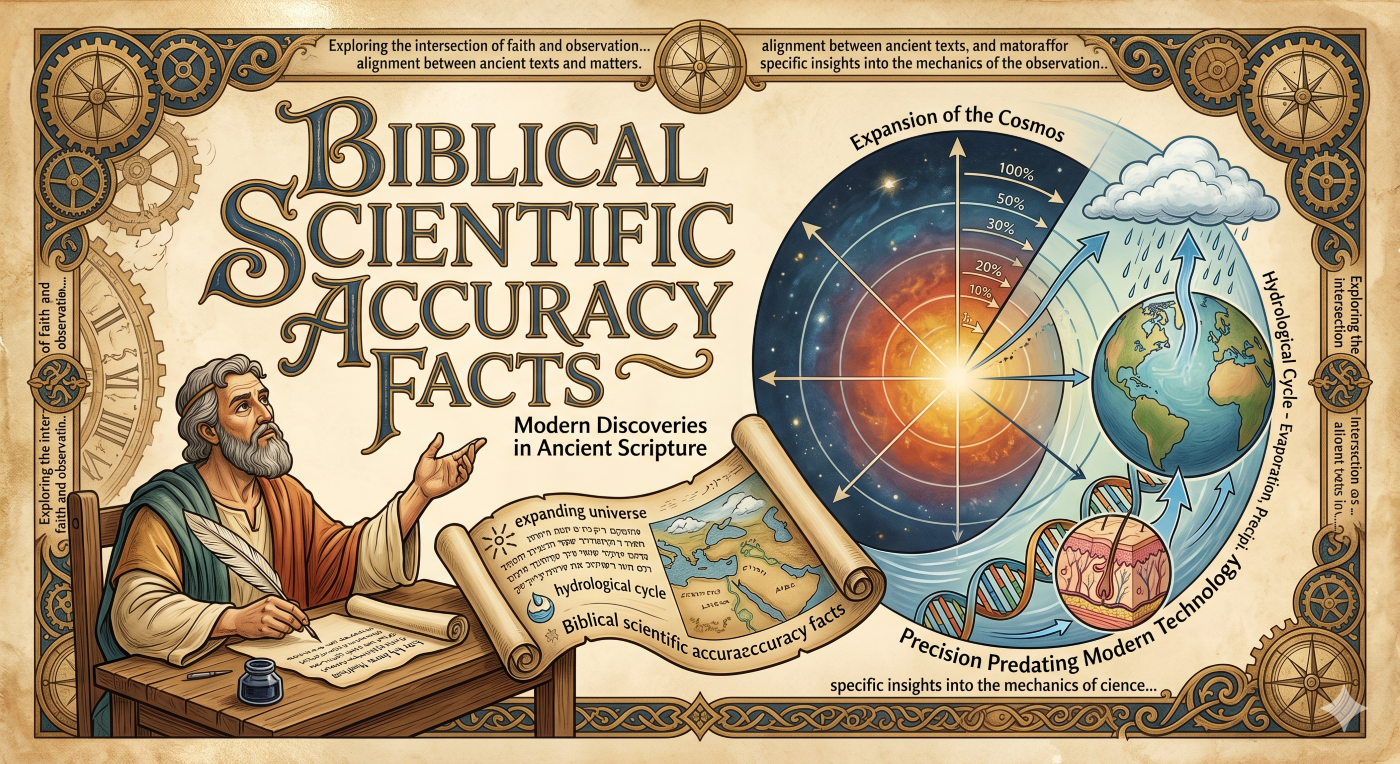
Understanding these alignments is crucial because it suggests that the Bible is not merely a book of moral fables or historical records, but a document that possesses an advanced understanding of the physical laws governing our lives. For the seeker or the skeptic, this level of accuracy serves as a "bridge of credibility." If the text is demonstrably accurate regarding the physical world that we can see and measure, it lends significant weight to its claims regarding the spiritual world that we cannot yet fully observe. It establishes a foundation of trust between the reader and the ancient text.
Astronomical Insights and Biblical Scientific Accuracy Facts
Long before the invention of the Hubble Telescope, the Bible spoke of a "stretching out" of the heavens. In Isaiah 40:22, it is written that God "stretches out the heavens like a curtain." This phrasing perfectly aligns with the modern cosmological discovery that the universe is not static, but is expanding in all directions. Furthermore, Job 26:7 states that He "hangs the earth on nothing," a revolutionary concept at a time when most civilizations believed the Earth was supported by physical pillars or mythological creatures.
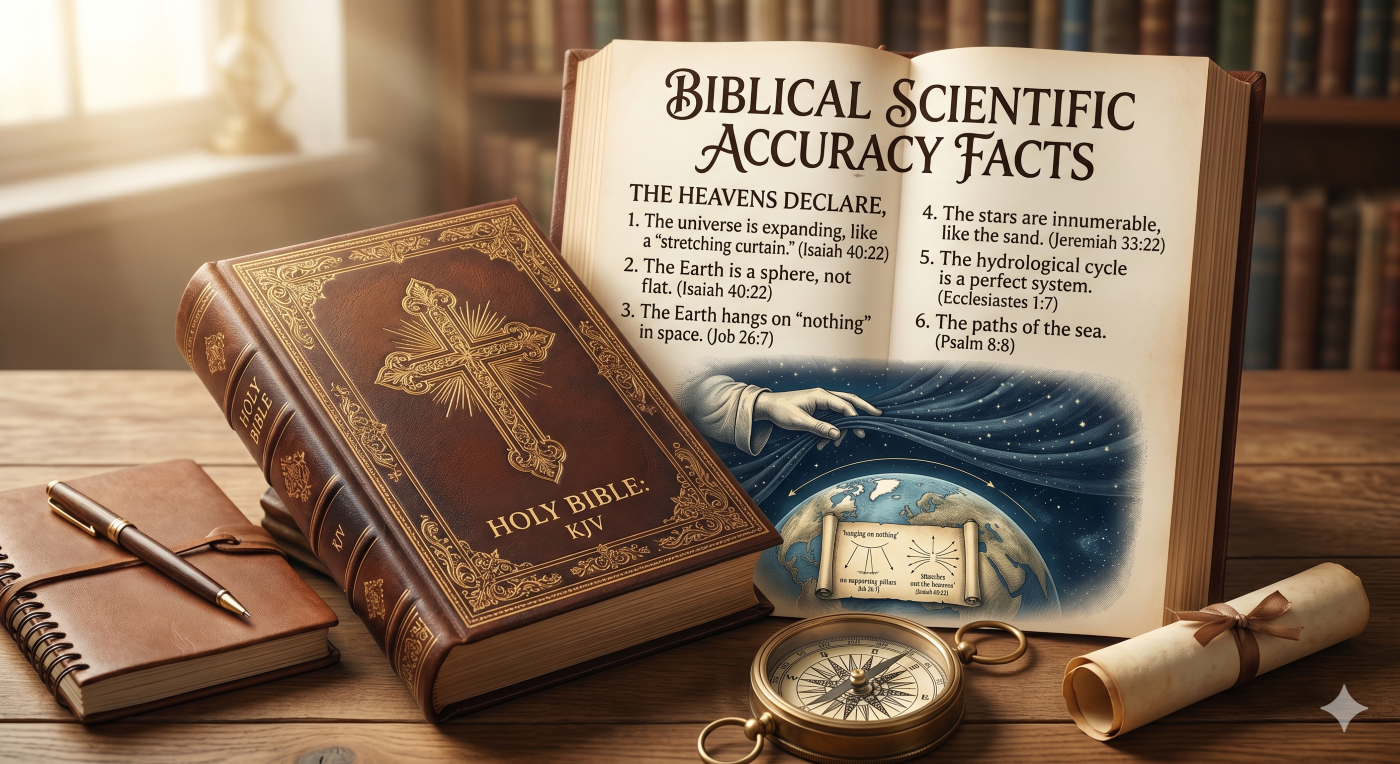
The significance of these astronomical descriptions lies in their defiance of contemporary "common sense." For thousands of years, the human eye perceived the stars as fixed points in a dome. The claim that space is "stretching" or that a massive planet is "hanging on nothing" would have seemed absurd to an ancient audience. This matters today because it shows that the Biblical record was not influenced by the scientific errors of its time. Instead, it provided a perspective that was "outside of time," offering a view of the cosmos that would only be verified by the high-powered mathematics and telescopes of the 20th century.
Hydrological Cycles as Biblical Scientific Accuracy Facts
The water cycle is a fundamental concept in modern science, yet it was detailed with incredible clarity in the Bible. Ecclesiastes 1:7 states, "All the rivers run into the sea, yet the sea is not full; to the place from which the rivers come, there they return again." This is a concise description of evaporation, precipitation, and runoff. Similarly, Amos 9:6 describes God as the one who "calls for the waters of the sea and pours them out on the face of the earth." In the realm of oceanography, Psalm 8:8 mentions "the paths of the seas," which directly led early explorers to identify the massive, predictable currents that move through our oceans like rivers.
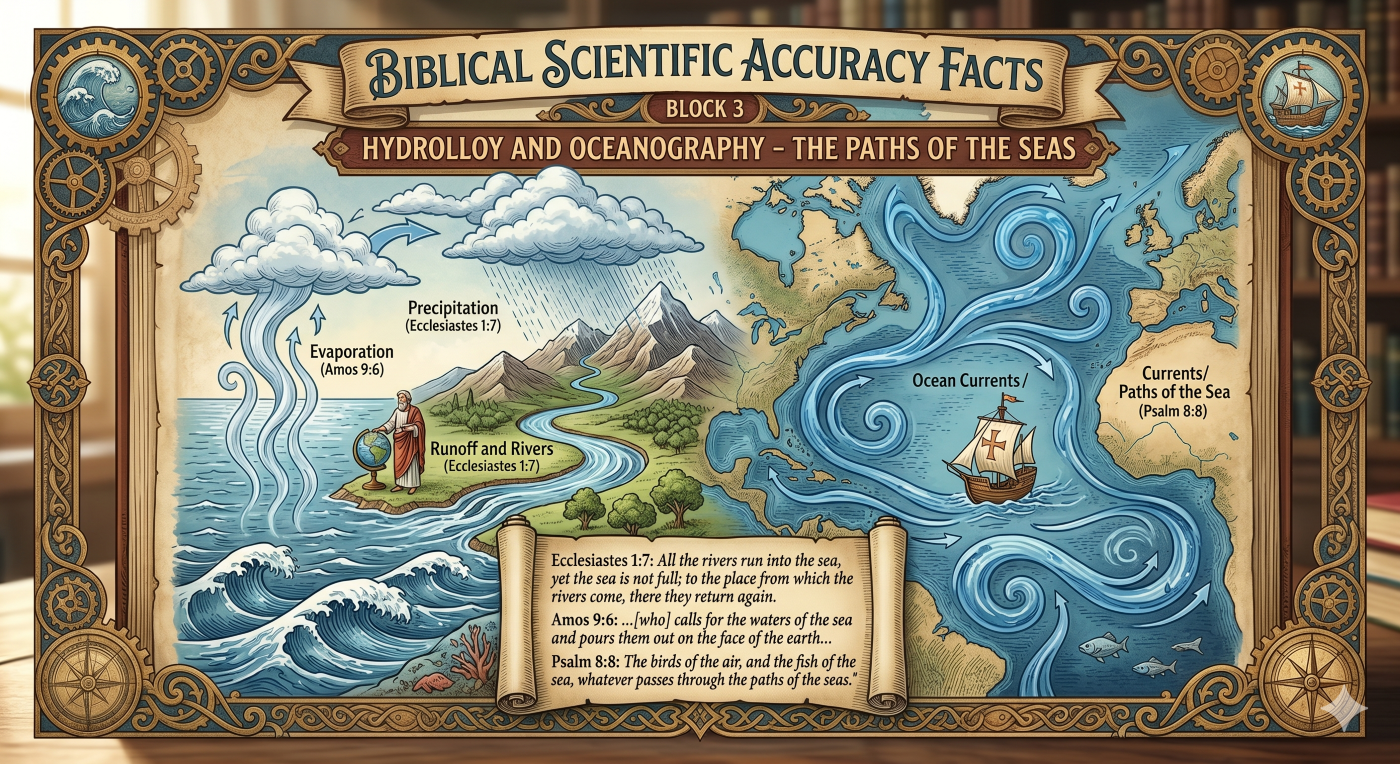
This level of detail is vital because it proves that the Bible recognizes the earth as a closed, finely-tuned system. In antiquity, many believed the world was chaotic and governed by the whims of unpredictable deities. By describing a systematic, repeatable water cycle and specific "paths" in the ocean, the Bible presents a world governed by order and design. For us, this matters because it encourages a scientific mindset—the belief that the world is "knowable" and that by studying these patterns, we can better steward the planet’s resources and navigate its vast environments safely.
Biological Principles and Sanitary Practices
One of the most profound areas of study involves the Mosaic Law and its instructions on hygiene. Thousands of years before "Germ Theory," Leviticus 15:13 instructed that those with a discharge must wash their clothes and "bathe his body in running water." For centuries, doctors often washed their hands in bowls of still water, inadvertently spreading disease, whereas the Bible insisted on "living" or running water. Additionally, Leviticus 17:11 declares that "the life of the flesh is in the blood," an insight that predates our understanding of how blood carries oxygen and life-sustaining nutrients to every cell in the body.
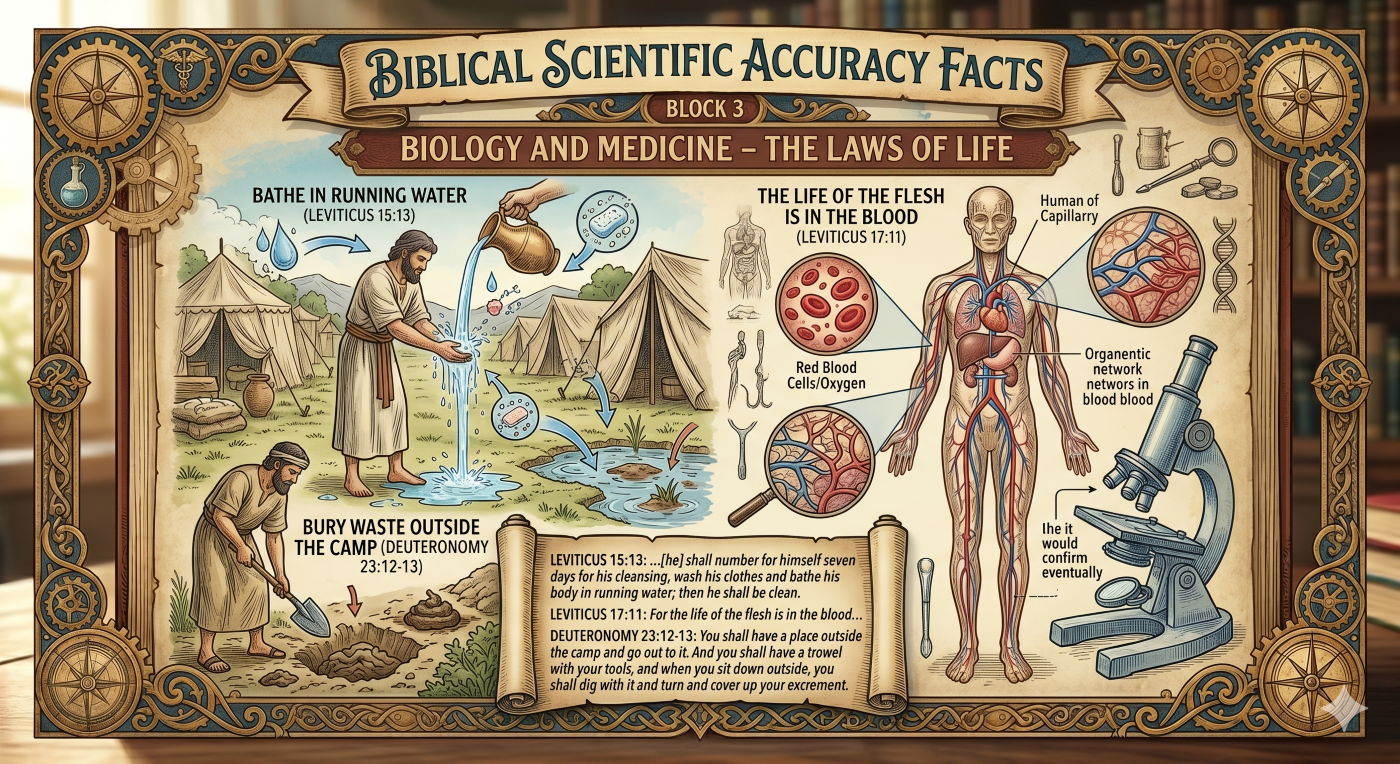
The practical application of these Biblical scientific accuracy facts has historically been a matter of life and death. During the Black Death and other plagues, communities that followed these ancient quarantine and washing rituals saw significantly lower mortality rates. This matters because it demonstrates a "preventative" wisdom that was far ahead of human discovery. It suggests that the laws provided in the Bible were not just religious rituals, but were designed with a deep, sophisticated knowledge of human biology and microbiology, intended to protect and preserve human life before humanity even knew "germs" existed.
Physical Laws and Biblical Scientific Accuracy Facts
The Second Law of Thermodynamics, or entropy, states that the universe is moving from a state of order to disorder—it is "winding down." This was described in Psalm 102:25-26, which says of the heavens and the earth: "They will perish... yes, all of them will grow old like a garment." Hebrews 1:11 repeats this, noting that the physical world is in a state of decay. This contradicts the ancient idea that the universe was eternal and unchanging, and it aligns with the modern understanding that energy becomes less available for work over time.
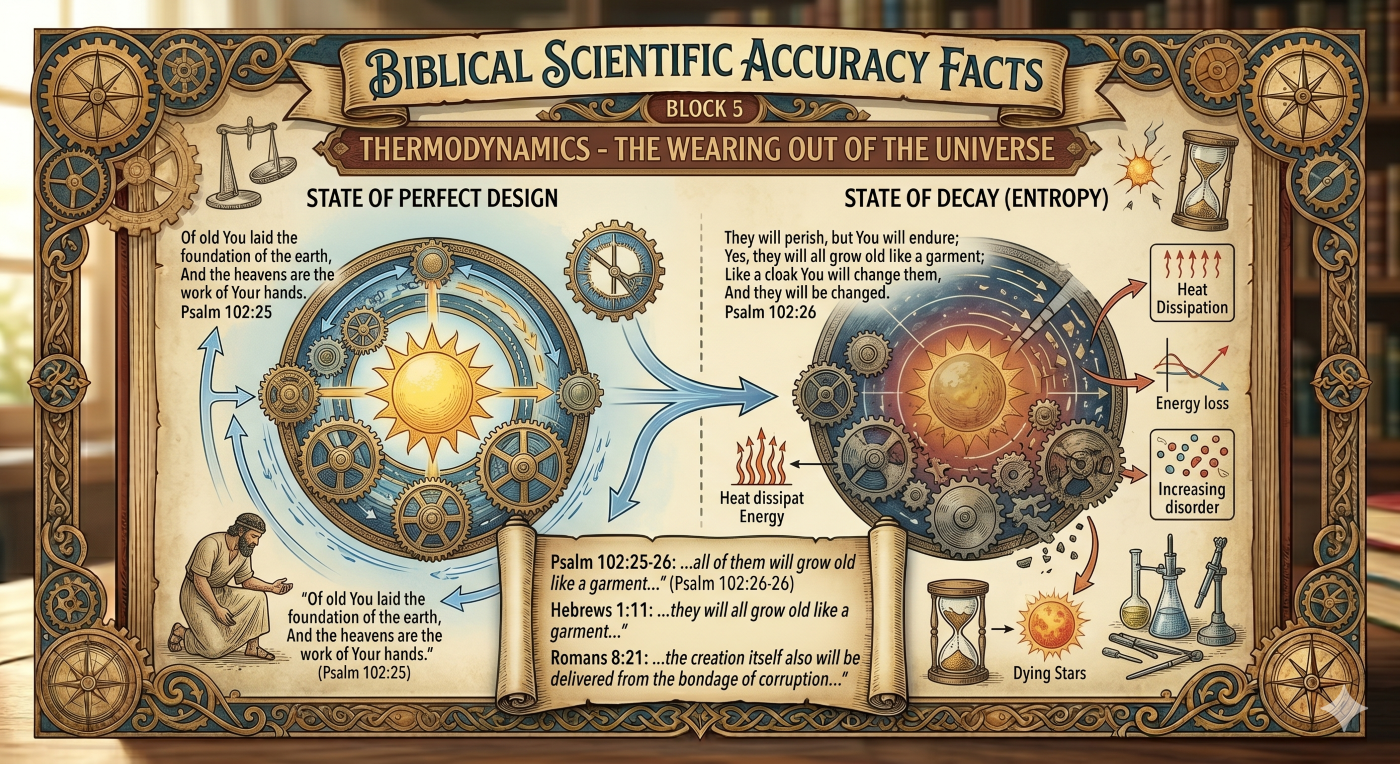
This matters because it addresses the very nature of time and existence. If the universe is "growing old," it must have had a beginning—a "winding up" point. This scientific reality, echoed in scripture, points toward a finite universe that requires an external cause. For the reader, this is significant because it aligns the Biblical narrative of a "Beginning" and an "End" with the most rigid laws of physics. It removes the Bible from the realm of the "mystical" and places it squarely within the observable laws of the physical world, showing that the text is grounded in the reality of the universe's lifecycle.
Geological Foundations as Biblical Scientific Accuracy Facts
The study of the Earth’s crust and the ocean floor has revealed features that were described in the Bible long before the advent of sonar or deep-sea exploration. In Job 38:16, the text asks, "Have you entered the springs of the sea? Or have you walked in search of the depths?" It wasn't until the 1970s, with the use of deep-diving submersibles, that scientists discovered hydrothermal vents—literally "springs" in the dark, deep ocean floor. Furthermore, Jonah 2:6 speaks of the "roots of the mountains" existing deep under the sea. Modern geology now confirms that many mountain ranges are indeed oceanic, and tectonic plates create "roots" that extend deep into the Earth's mantle.
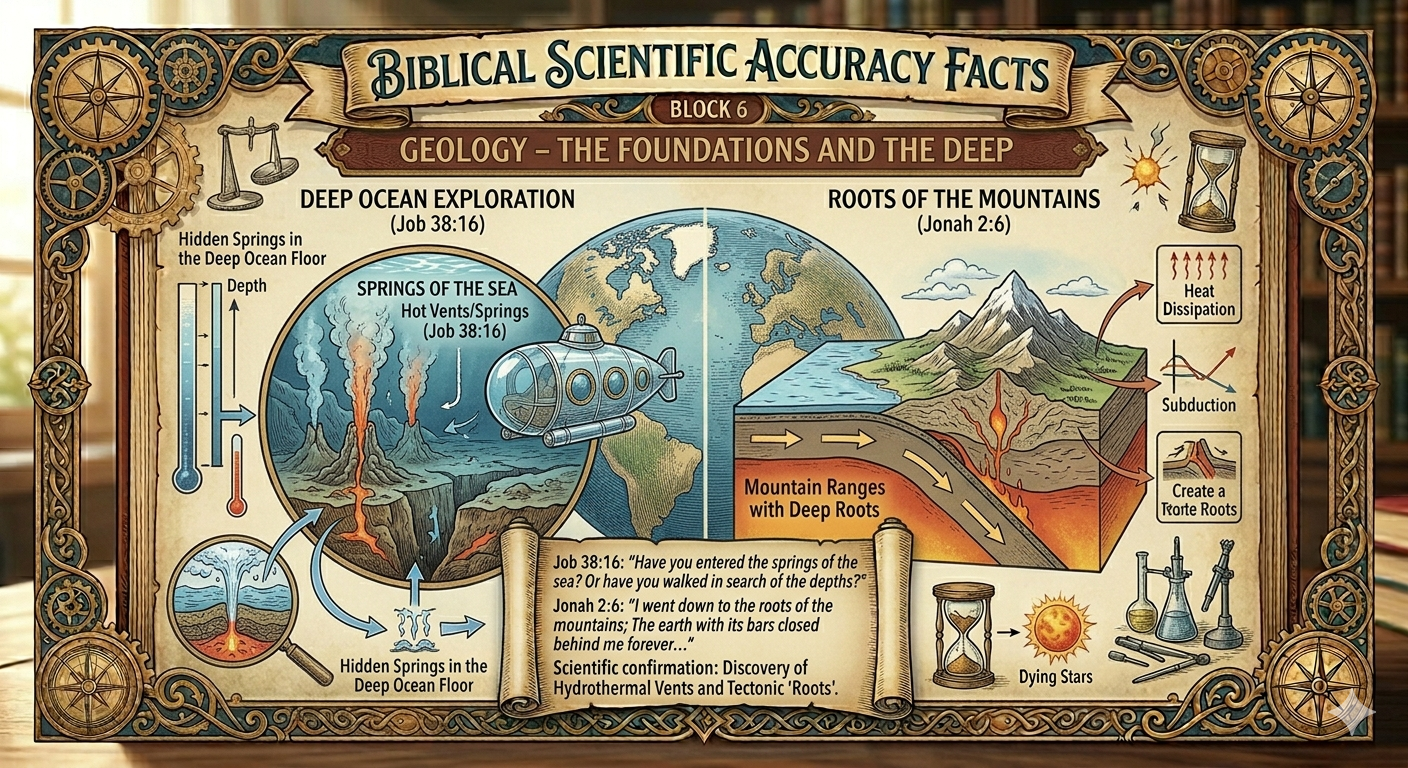
This geological insight is significant because it describes a part of the world that was utterly inaccessible to the writers of antiquity. No human in the time of Job or Jonah could have dove to the bottom of the ocean to verify the existence of freshwater springs or underwater mountain bases. This matters today because it reinforces the idea that the Bible’s descriptions are based on an "eyewitness" account of the Earth’s construction from the perspective of the Creator. It provides a sense of "depth" to Biblical scientific accuracy facts, showing that the text is as accurate regarding the hidden foundations of the Earth as it is regarding the visible stars in the sky.
The Synthesis of Faith and Fact
The study of Biblical scientific accuracy facts does not diminish the spiritual message of the Bible; rather, it strengthens the bridge between the Creator and the creation. By completing this seven-fold look at the natural world—from the heights of the heavens to the depths of the sea—we find a consistency that is rare in ancient literature. As we continue to use our most advanced tools to uncover the mysteries of DNA and the deep reaches of space, we find that these ancient words often had the answer waiting for us all along.
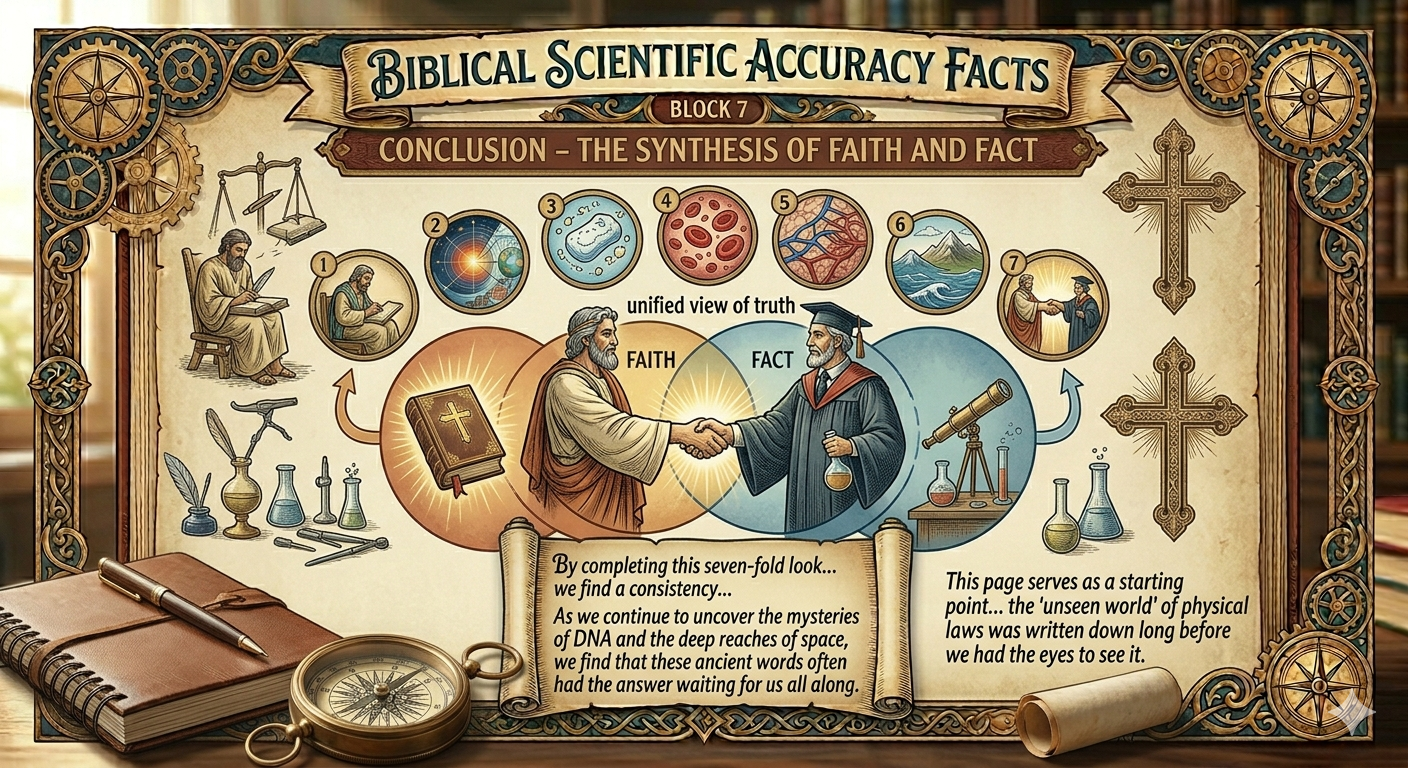
Ultimately, the harmony between science and scripture matters because it encourages a unified view of truth. We do not have to check our intellect at the door to have faith, nor do we have to ignore ancient wisdom to be scientific. By recognizing these facts, we see a universe that is consistent, designed, and described with an accuracy that points toward a single, coherent Source. This page serves as a starting point for anyone looking to see how the "unseen world" of physical laws was written down long before we had the eyes to see it.
For further exploration of the harmony between science and scripture, visit Reasons to Believe.
Beyond Science: Deepening Your Study of the Scriptures
While Biblical scientific accuracy facts provide a solid physical foundation for the validity of the Bible, they are only the beginning of the journey. To truly understand the narrative of our world and the spiritual forces at play, we must look deeper into the history and the supernatural elements described in the text. Whether you are interested in the origins of the Word itself or the complexities of the spiritual realm, the following resources will help you expand your understanding:
- History of the Bible: Trace the miraculous preservation and chronological timeline of the scriptures.
- History of Satan: Examine the origin, fall, and ultimate defeat of the adversary as recorded in the Bible.
- Alien Deception: A critical look at modern phenomena through the lens of biblical prophecy and spiritual warfare.
- Spirits, Ancestors, and the Afterlife: Understanding what the Bible says about the soul, the spirit realm, and our eternal destination.


