The Black Horse of Revelation: Meaning of the Third Seal and the Black Horse of the Apocalypse
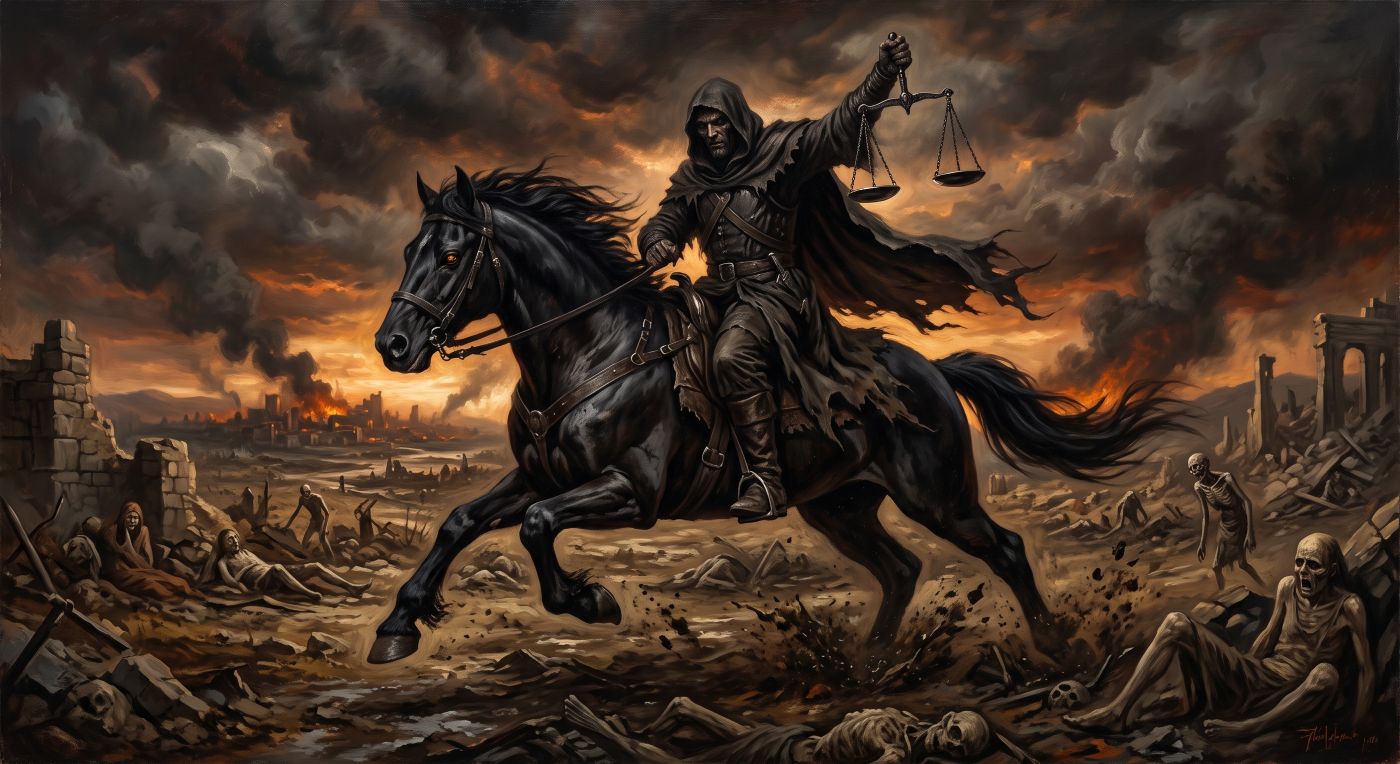
The opening of the third seal in the Book of Revelation introduces one of the most sobering visions in biblical prophecy: the black horse of revelation. Driven by a rider atop a dark steed holding a pair of scales, this prophetic figure—widely known as the black horse of the apocalypse—has intrigued theologians, historians, and students of prophecy for centuries. While the imagery is brief—spanning just two verses in Revelation 6—the weight of its symbolism carries monumental implications for world events, global economics, and the future of human society. By examining the biblical text alongside primary prophetic frameworks, we can uncover what this critical prophecy portends for the end times.
What Is the Black Horse of Revelation?
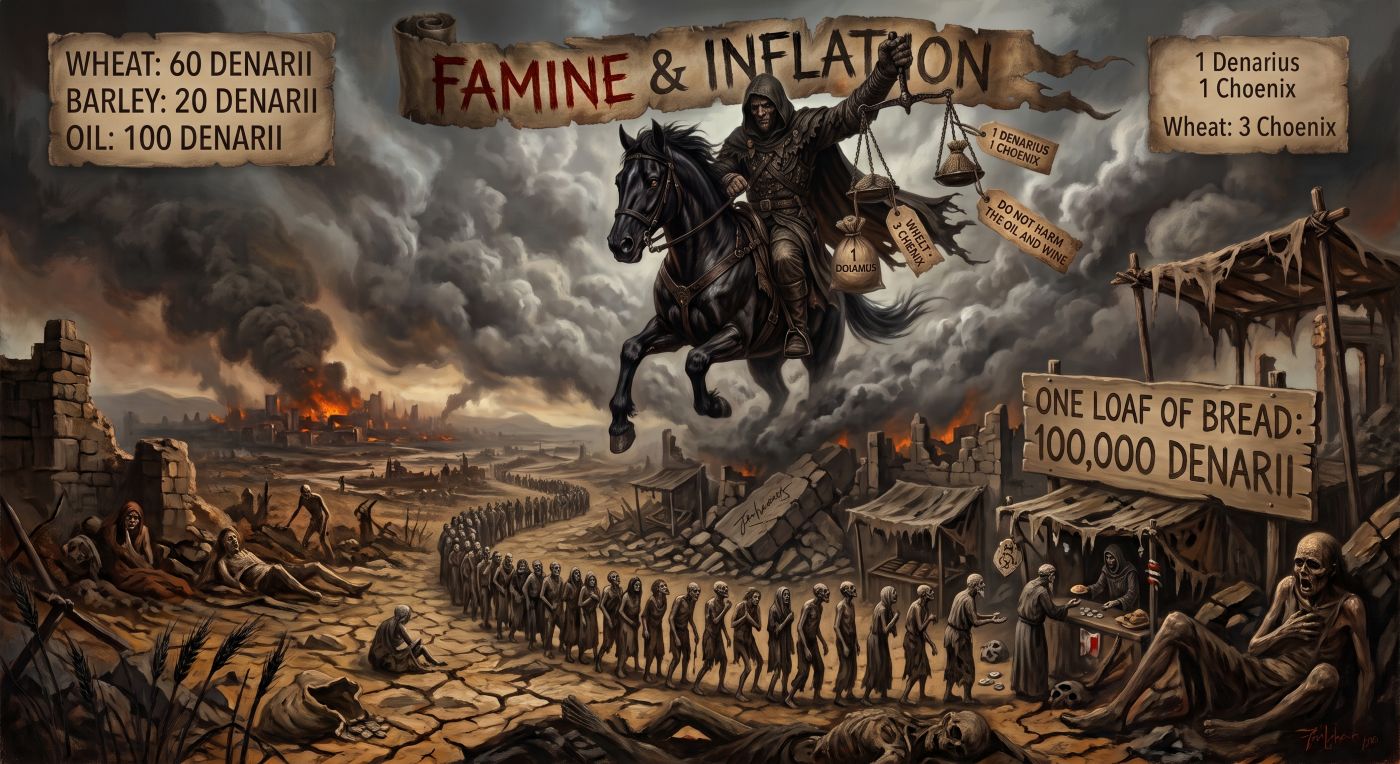
To understand the black horse of revelation, one must first look directly at the Scripture where this figure appears. Revelation 6:5–6 states:
"And when he had opened the third seal, I heard the third beast say, Come and see. And I beheld, and lo a black horse; and he that sat on him had a pair of balances in his hand. And I heard a voice in the midst of the four beasts say, A measure of wheat for a penny, and three measures of barley for a penny; and see thou hurt not the oil and the wine."
In biblical symbolism, color holds deep meaning. While white signifies victory or counterfeit peace, and red represents bloodshed, black universally symbolizes famine, mourning, despair, and national calamity. The rider of the black horse of revelation holds a pair of scales or balances (zygōn in Greek), an instrument traditionally used in commerce to weigh food and goods. In times of abundance, food is sold by volume; in times of extreme scarcity, every morsel must be weighed with exacting precision.
The voice heard in the midst of the four living creatures dictates the going rate for basic sustenance: "a measure of wheat for a penny." A "measure" (choenix) was approximately the daily amount of grain required to keep an adult alive, while a "penny" (denarius) represented a full day's wage for a Roman laborer. In practical terms, this vision depicts a severe economic crisis where an entire day of hard labor yields only enough food to feed a single person, leaving nothing left for shelter, clothing, utilities, or family members.
Simultaneously, the command to "hurt not the oil and the wine" provides crucial context. Olive oil and wine were dietary staples and luxuries of the wealthy in the ancient Mediterranean. This detail indicates that while basic necessities like bread become virtually unobtainable for the working class, luxury goods remain intact—highlighting a stark economic divide and hyperinflation that targets essential foodstuffs while protecting elite interests.
The Futurist Viewpoint: World War III, the Antichrist, and Economic Collapse
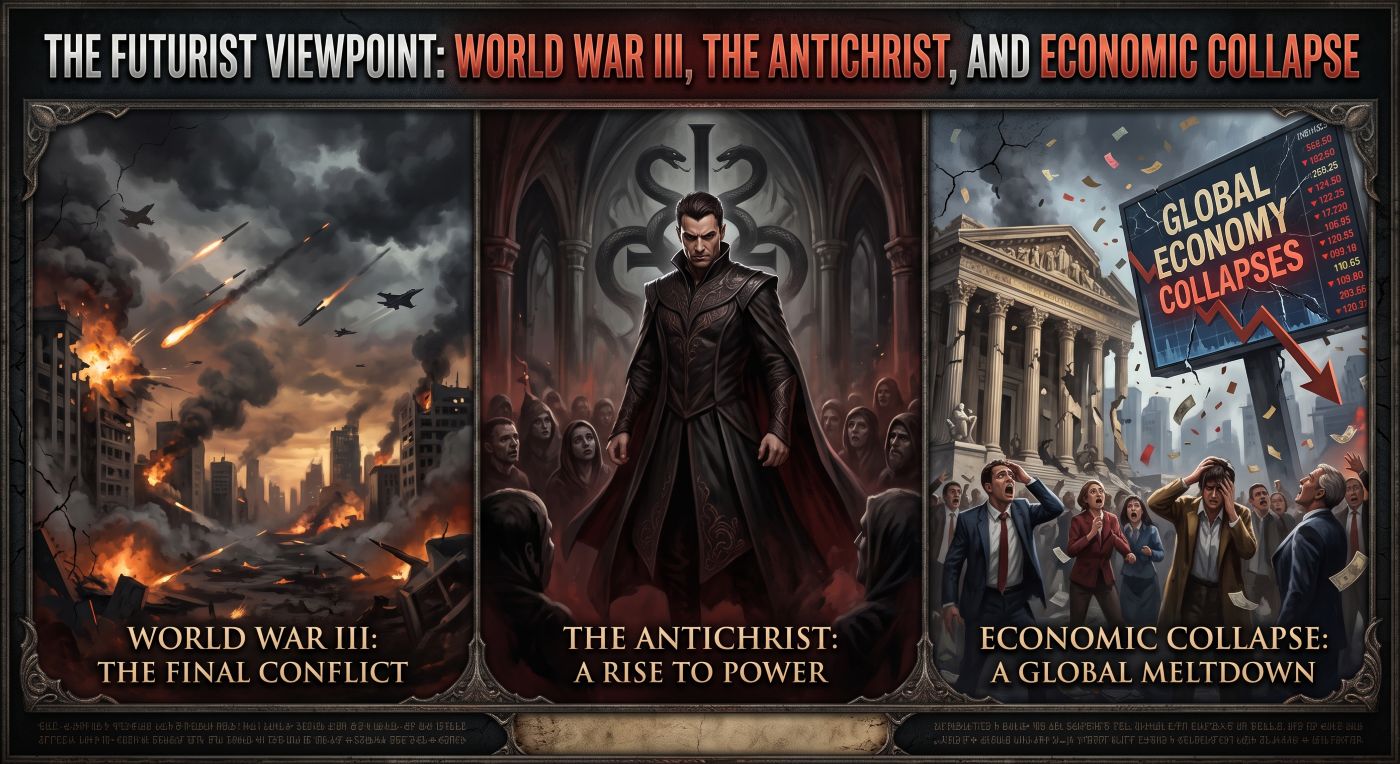
Among the various prophetic interpretations, the Futurist viewpoint presents the most direct, chronological, and logical progression of events surrounding the black horse of the apocalypse. Futurism holds that the events described in Revelation 4 through 22 refer to real, literal events that will take place in a specific, future period known as the Tribulation.
Under this framework, the Four Horsemen of the Apocalypse do not ride simultaneously or at random; they ride in a strict, cause-and-effect sequence triggered by the opening of the seals by Jesus Christ, the Lamb of God. The arrival of the black horse of revelation is central to this sequence.
1. The Setup: The White Horse and False Peace
The sequence begins with the opening of the first seal (Revelation 6:1–2), revealing a rider on a white horse who goes forth "conquering, and to conquer." In Futurist eschatology, this rider is not Jesus Christ, but the Antichrist—a charismatic global leader who emerges during a time of international instability. He rises to global dominance on a platform of diplomacy, promising order, security, and global unity. He successfully negotiates a grand peace covenant, positioning himself as the savior of a fractured world.
2. The Catalyst: The Red Horse and World War III
However, this counterfeit peace is short-lived. The second seal opens (Revelation 6:3–4) to reveal the red horse, whose rider is granted power "to take peace from the earth, and that they should kill one another." The false stability established by the Antichrist shatters as global conflicts erupt into full-scale warfare—what many prophetic scholars view as World War III. Advanced military technology, broken treaties, and geopolitical strife plunge the nations into chaos.
3. The Result: The Black Horse and Global Famine
The appearance of the black horse is the direct, catastrophic consequence of the red horse’s military destruction. War inherently devastates human infrastructure and natural resources:
- Agricultural Disruption: Farmland is scorched or contaminated, livestock is destroyed, and rural workforces are conscripted or displaced.
- Supply Chain Failure: Trade routes, transportation hubs, shipping lanes, and processing plants are bombed or shut down.
- Currency Devaluation: Governments print money rapidly to fund war efforts, causing runaway hyperinflation.
When war ravages global agricultural networks, severe famine naturally follows. The rider on the black horse of revelation represents the economic aftermath of world war. In a modern context, this scenario aligns with a centralized global economy breaking under the weight of conflict, leading directly to controlled food rationing, digital currency oversight, and severe price gouging. The Futurist perspective clearly demonstrates that the black horse of the apocalypse is not an isolated event, but the unavoidable result of human conflict under the reign of the Antichrist.
The Economic Viewpoint: The Collapse of Capitalism and Modern Wealth Disparity
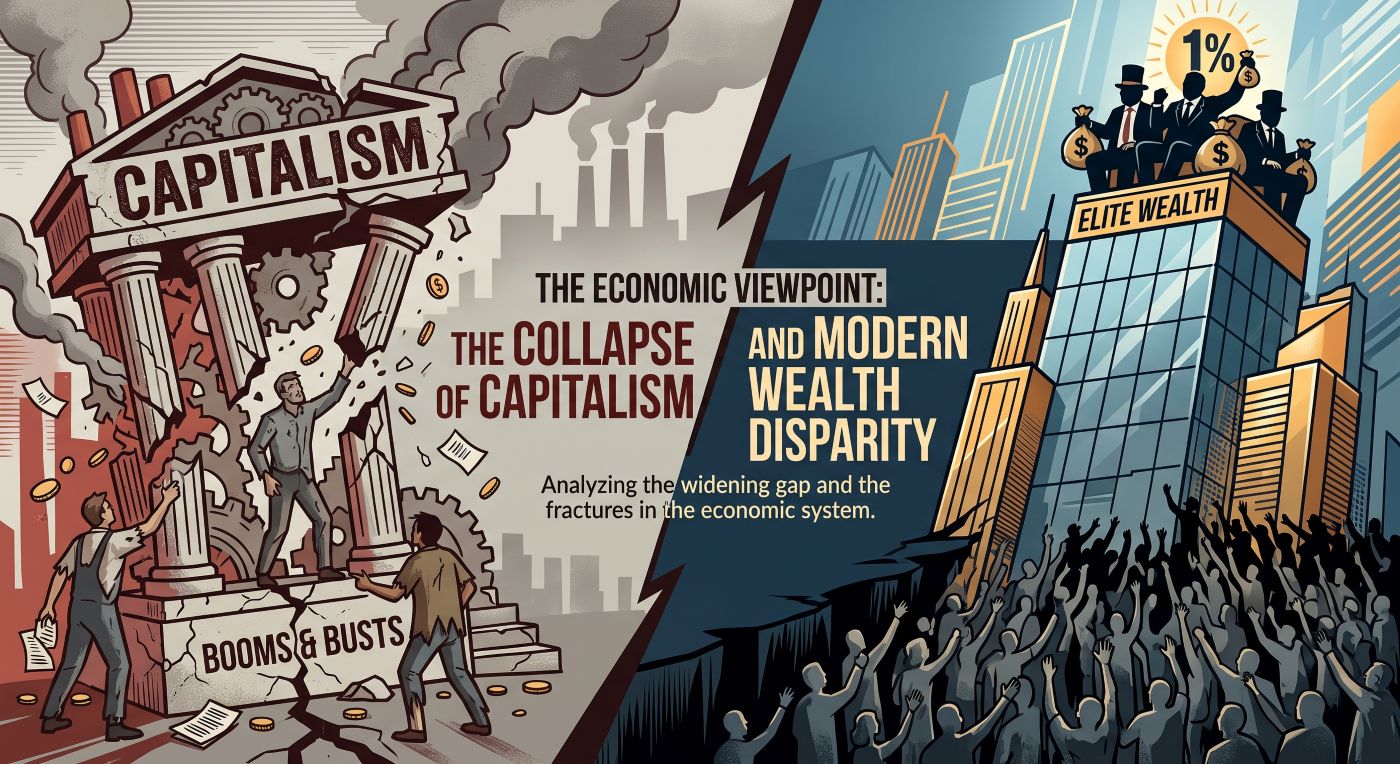
A second major perspective interprets the vision through an economic lens, viewing the rider with the scales as a representation of unchecked commercial systems and the eventual downfall of global capitalism. Proponents of this view point out that the rider on the black horse of revelation does not hold a sword, a bow, or a scythe; he holds the primary instrument of ancient commerce—the balance.
In a capitalist system driven by open markets, supply and demand dictate the price of commodities. However, when corporate monopolies, globalist policies, financial speculation, and wealth concentration reach an extreme, the system becomes dangerously top-heavy. The third seal illustrates a market system that has completely broken down, where basic human survival is dictated by financial manipulation and severe inequality.
Hyperinflation and Currency Collapse
The phrase "a measure of wheat for a penny" is a classic illustration of hyperinflation. Throughout history, when fiat currencies lose their purchasing power due to excessive debt, central banking manipulation, or systemic failure, basic survival goods skyrocket in price. We have seen historical previews of this phenomenon in 1920s Weimar Germany, post-war nations, and modern nations suffering economic collapse, where citizens required wheelbarrows of paper money just to buy a loaf of bread.
The Elite Exemption: "Hurt Not the Oil and Wine"
The command to protect the oil and wine strongly mirrors modern economic disparity. During severe recessions and market panics, the working class often bears the brunt of inflation, job loss, and food shortages, while the ultra-wealthy elite remain insulated—or even profit from the crisis. The oil and wine symbolize luxury items that remain out of reach for the starving masses, yet freely traded among the ruling class.
Under this interpretation, the black horse of revelation serves as a prophetic warning regarding the terminal state of materialist economic systems. Unrestricted greed, currency debasement, and corporate consolidation create a volatile environment where a single global shock can cause the entire financial edifice to crumble, forcing the population into total dependence on state rationing.
Alternative Interpretations: Historicist and Idealist Views
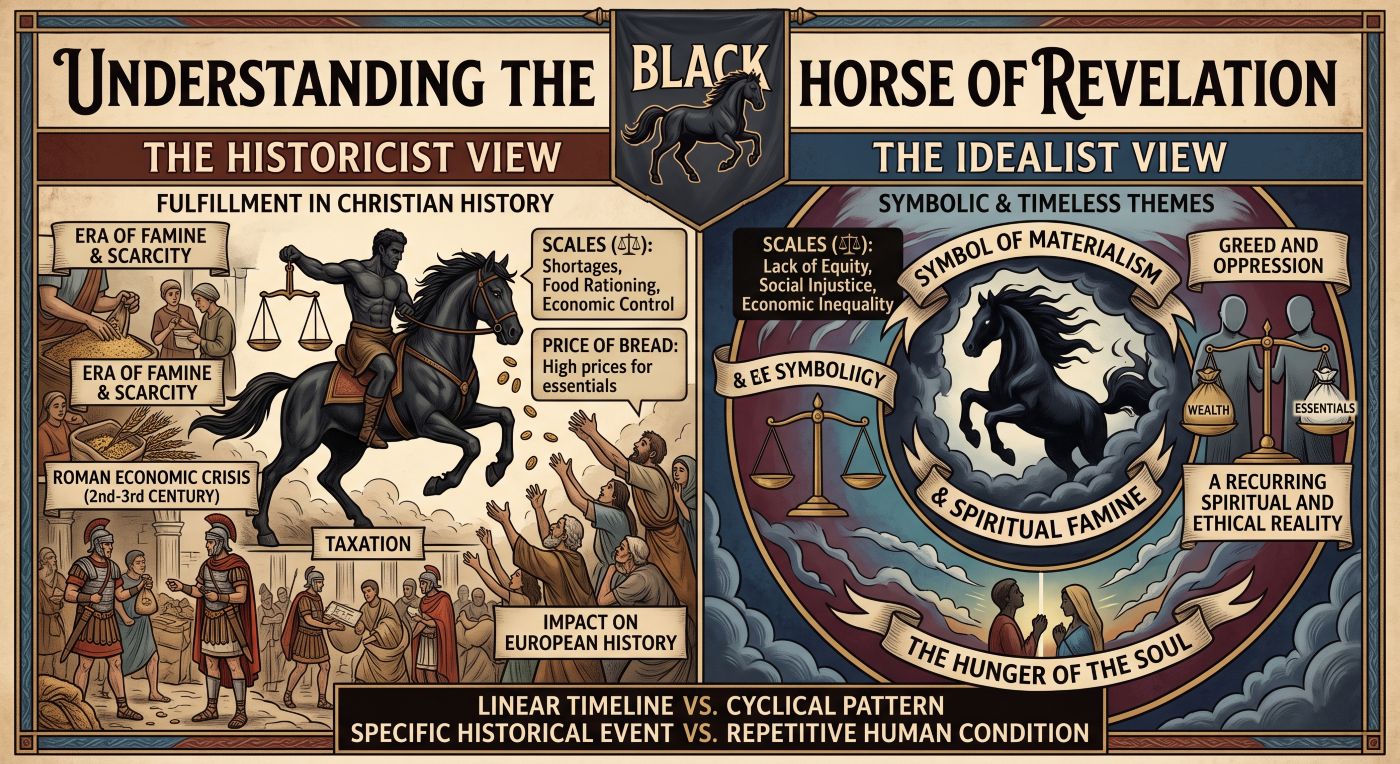
The Historicist Viewpoint
Historicism views the Book of Revelation as a continuous, chronological timeline of church history unfolding from the first century AD to the end of the age. Historicist scholars typically map the Four Horsemen onto specific epochs of the Roman Empire:
- The White Horse represents the prosperous era of Roman expansion (AD 96–180).
- The Red Horse signifies the period of Roman civil wars and military anarchy.
- The Black Horse of Revelation represents the severe taxation, economic oppression, and agrarian distress that plagued the Roman Empire during the 3rd century AD, particularly under emperors like Caracalla who levied heavy taxes on the working class.
Why it falls short: While the Roman Empire certainly experienced financial crises and heavy taxation, limiting a cosmic prophecy of Revelation to ancient Mediterranean history diminishes its global scope and ultimate prophetic resolution.
The Idealist Viewpoint
Idealism (sometimes called the spiritual or allegorical view) sees Revelation not as a description of specific historical or future events, but as a symbolic depiction of the ongoing spiritual struggle between good and evil throughout all of human history.
In the Idealist view, the black horse does not represent a specific future famine or historical empire. Instead, it symbolizes the recurring reality of human suffering, injustice, poverty, and economic hardship that exists in every generation until the return of Christ.
Why it falls short: By treating the text purely as a timeless metaphor, Idealism strips the prophecy of its concrete urgency. It overlooks the explicit sequential nature of the seals and fails to account for the specific end-time scenario that Scripture repeatedly warns humanity to prepare for.
Comparing the Primary Viewpoints
To better understand how these interpretations differ in their scope, application, and timeline, consider the following comparison:
The Prophetic Timeline: What Lies Ahead?
When analyzing the vision of the black horse of revelation, the weight of evidence points toward a literal, future fulfillment that will affect every inhabitant of the earth. The convergence of global instability, fragile supply networks, national debt crises, and escalating international tensions suggests that the conditions necessary for the third seal are actively taking shape today.
The Bible presents this vision not to induce panic, but to grant spiritual foresight and understanding. The sequential progression of the Four Horsemen serves as a divine roadmap:
- Watch for false peace: The rise of a global leader offering unified solutions to world crises (The White Horse).
- Watch for sudden conflict: Geopolitical wars that break global security and destroy critical infrastructure (The Red Horse).
- Watch for economic control: Severe inflation, food scarcity, and centralized control over buying and selling (The Black Horse).
As the third seal demonstrates, a world torn by war and financial ruin becomes ripe for total control. The rider on the black horse of Revelation prepares the stage for the ultimate economic trap—a system where access to basic food and life necessities will require complete allegiance to a global authority. Understanding the reality of the third seal empowers believers and students of prophecy to discern the signs of the times, ground their trust in divine providence, and remain vigilant as end-time events unfold.
Recommended External Resource
For additional verse-by-verse commentary and historical context on the prophetic timeline of the Four Horsemen, including the opening of the Third Seal, explore the comprehensive study provided by GotQuestions Ministries:
Read: What are the four horsemen of the apocalypse? →Deepen Your Understanding: Related Prophecy Studies
Understanding the third seal is only one piece of the broader end-times framework. To see how these events fit into the complete prophetic sequence—and how surrounding cultural and spiritual trends intersect with Scripture—explore these related studies:
- The White Horse Of The Apocalypse: Examine the identity and strategy of the rider on the first horse, who emerges on a platform of peace and global unity before chaos unfolds.
- The Red Horse Of The Apocalypse: Learn how the second seal removes peace from the earth, unleashing global conflict and World War III that directly causes the economic collapse of the black horse.
- The 1948 Bible Prophecy Connection: Discover the significance of Israel’s rebirth as a nation in 1948 and why many prophecy scholars consider it the foundational ticking clock for end-times events.
- Astrology and The Bible: Analyze what Scripture teaches regarding celestial signs, stargazing, and modern occult influences versus God's sovereign control over history.


