Dinosaurs and the Bible: Solving the Ancient Mystery

For centuries, a silent mystery has captivated the minds of truth-seekers, researchers, and believers alike: how do we reconcile the massive, fossilized bones buried in the earth with the sacred pages of ancient scripture? The intersection of dinosaurs and the bible is one of the most highly debated topics in biblical history, often leaving people with more questions than answers. When we look at the towering remains of a Tyrannosaurus Rex or a massive Sauropod, we naturally wonder where these incredible creatures fit into the grand design. Are they remnants of a forgotten world shrouded in prehistoric darkness, or did they walk the earth alongside humanity, leaving their footprints in the same soil?
To uncover the truth, we have to look past modern assumptions and look directly at the text itself. By exploring the deep mysteries of scripture, ancient Hebrew word meanings, and the historical record, we can begin to piece together the puzzle. The relationship between dinosaurs and the bible does not have to be a contradiction. In fact, when you know what to look for, the supernatural timeline of the earth begins to make perfect sense, revealing an unseen world where these magnificent monsters played a specific role in the unfolding of history.
Why is the Word Dinosaur Missing from Scripture?
When people begin investigating dinosaurs and the bible, the very first roadblock they usually hit is a simple question: why doesn't the Bible actually use the word "dinosaur"? If these massive creatures were a significant part of God's creation, their absence from the English text feels like a glaring omission. However, the explanation for this is remarkably simple, and it comes down to a matter of modern linguistics rather than a biblical oversight.
The word "dinosaur" was not coined until the year 1841. A brilliant English paleontologist named Sir Richard Owen came up with the term by combining two Greek words: deinos, meaning terrible, potent, or fearfully great, and sauros, meaning lizard or reptile. Therefore, a "dinosaur" is literally a "fearfully great reptile." Because the King James Version of the Bible was translated into English way back in 1611—more than two centuries before Owen invented the word—it was linguistically impossible for the translators to include it.
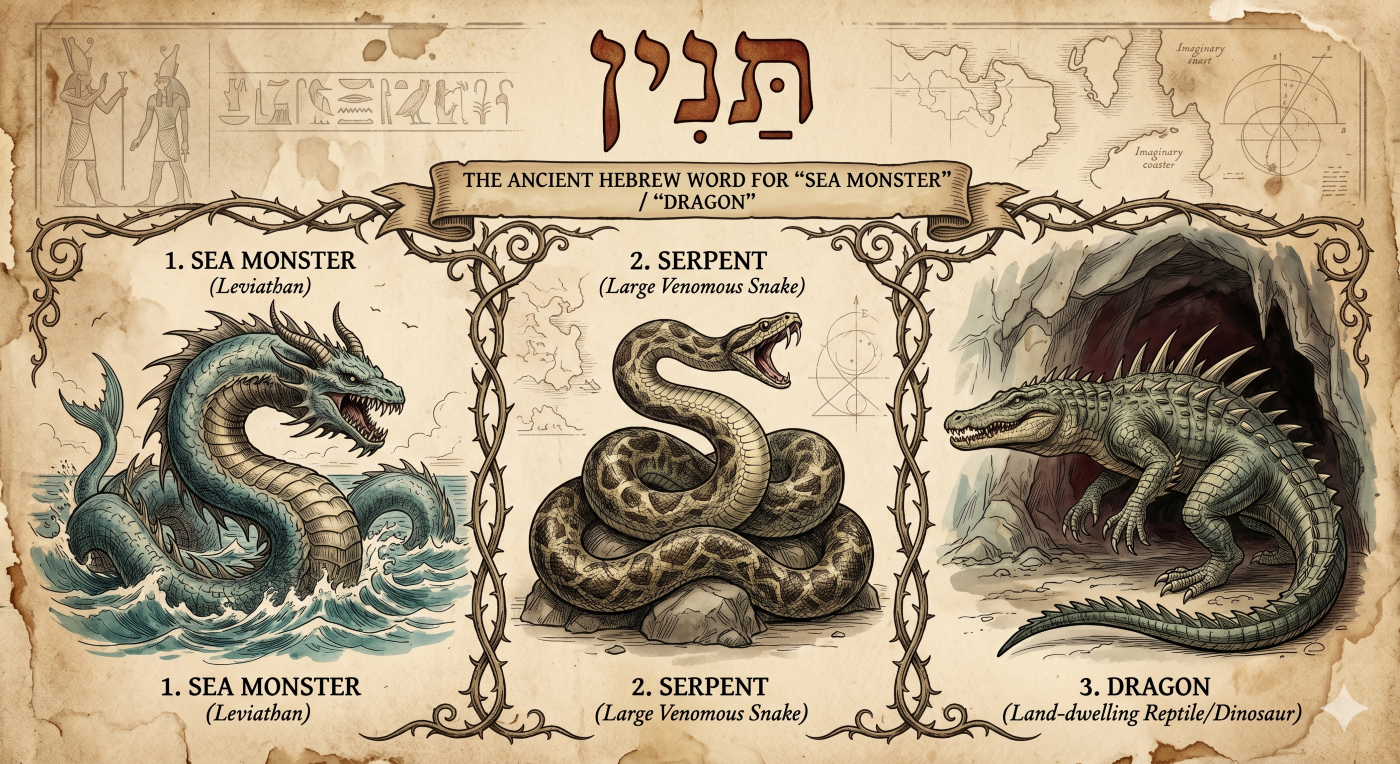
So, what terms did the ancient writers use instead? In the original Hebrew scriptures, we repeatedly find the word tannin. Depending on the context of the passage, tannin is translated into English as "dragon," "sea monster," "serpent," or "whale."
We see this word used dramatically throughout the Old Testament. For instance, in Genesis 1:21, it is used to describe the very first giant creatures ever created: "And God created great whales [tannin], and every living creature that moveth..." It appears again in Isaiah 27:1, which speaks of a terrifying reptile lurking in the depths: "...and he shall slay the dragon [tannin] that is in the sea." Even in Jeremiah 51:34, a predatory, land-dwelling monster is invoked: "...he hath swallowed me up like a dragon [tannin], he hath filled his belly with my delicates..."
Throughout antiquity, cultures all over the globe spoke of these "dragons"—massive, scaled, awe-inspiring reptiles that ruled the land, seas, and skies. When we look at the descriptions of these historical monsters alongside the true root meaning of tannin, they match our modern understanding of dinosaurs with astonishing accuracy. The Bible talks about these creatures extensively; it simply used the vocabulary of its time to describe them.
Dinosaurs and The Bible in a Pre-Adamic Earth
The first major creationist perspective we must examine proposes that a significant "gap" of time exists in the opening verses of Genesis. This concept, known as the Gap Theory, offers a profound explanation for the presence of dinosaurs and the bible. Proponents of this view look closely at the precise Hebrew wording of Genesis 1:1 and 1:2.
Genesis 1:1 states: "In the beginning, God created the heaven and the earth." This describes a perfect, complete original creation. But Genesis 1:2 begins with a dramatic shift: "And the earth was without form, and void; and darkness was upon the face of the deep."
The core of the Gap Theory hinges on that word "was." The Hebrew root word is hayah, which can be translated as "became" or "had become." (Think of Lot's wife becoming a pillar of salt—the same root word hayah is used). Gap theorists argue that the structural phrase used in Genesis 1:2, hayah tohu vavohu, is more accurately translated as "it became without form and void." This translation implies a massive, cataclysmic event occurred between these two verses. This judgment plunged the original, perfect creation into chaotic darkness, rendering it tohu (without form) and bohu (void).
But what was this original creation, and why was it judged? This is where proponents place the world of the dinosaurs. They believe these great creatures belonged to a pre-Adamic earth, a complex ecosystem that flourished long before the current six-day restoration period. This theory beautifully resolves the question of dinosaurs and the bible by suggesting they inhabited an entirely different epoch of history. This world was ultimately judged and destroyed, perhaps coinciding with the rebellion and fall of Lucifer, leaving only a ruined, water-logged planet from which the modern six-day creation story emerges.
Scriptural Evidence for an Ancient, Judged Earth

This interpretation of dinosaurs and the bible isn't based solely on the ambiguity of a single Hebrew word. Supporters of the Gap Theory point to several other specific scriptures that describe a pristine creation being suddenly and violently laid waste.
A primary example is found in the prophets. Look at Isaiah 24:1: "Behold, the LORD maketh the earth empty, and maketh it waste, and turneth it upside down, and scattereth abroad the inhabitants thereof." This strong language paints a picture of intense, divine judgment—one that literally "scatters" and empties the planet. Gap theorists see this as a perfect description of the catastrophe that closed the pre-Adamic "Age of Dinosaurs."
Even more striking is the passage in Jeremiah 4:23-26, which many scholars argue is a direct visionary reference to the cataclysm of Genesis 1:2: "I beheld the earth, and, lo, it was without form, and void [tohu and bohu]; and the heavens, and they had no light. I beheld the mountains, and, lo, they trembled, and all the hills moved lightly. I beheld, and, lo, there was no man, and all the birds of the heavens were fled..." This chilling description explicitly mentions the exact same chaotic state ("without form, and void") seen in Genesis 1:2, but crucially adds details: it was a place where "there was no man," yet the topographical landmarks (mountains) and other life forms (birds) already existed, implying they had fled a great judgment. When we synthesize these parallel texts, the possibility of an original creation that suffered total destruction begins to look scripturally sound, offering a compelling explanation of where dinosaurs and the bible converge in pre-history.
Coexistence, Noah’s Flood, and Dinosaurs and The Bible

The second major creationist perspective takes a completely different chronological approach to dinosaurs and the bible. Rather than placing these massive reptiles in a hidden era prior to Adam, this group of scholars argues that dinosaurs were created on the very same sixth day of creation as humanity. Under this model, humans and dinosaurs shared the earth simultaneously, walking the pristine ecosystem of the pre-flood world together. Proponents of this view look to the foundational text of Genesis 1:24-25 to anchor their timeline: "And God said, Let the earth bring forth the living creature after his kind, cattle, and creeping thing, and beast of the earth after his kind: and it was so." Since dinosaurs are fundamentally land animals, they naturally fall under the classification of the beasts and creeping things brought into existence on day six.
If this timeline is accurate, it means that the incredible variety of dinosaurs lived alongside ancient human civilizations for over 1,600 years leading up to the great cataclysm. They were not distant, prehistoric myths; they were part of the everyday reality of the anti-diluvian world. This viewpoint completely reframes the narrative of dinosaurs and the bible, suggesting that the global fossil record we find today isn't a graveyard from a forgotten pre-Adamic judgment, but rather a direct monument to the sudden, violent burial of millions of creatures during the year-long global deluge recorded in the days of Noah.
Scriptural Evidence for Coexistence and Noah’s Flood
To support the idea that these creatures lived alongside man and faced the deluge, creationists point to the strict mandates given to Noah. According to Genesis 6:19, Noah was commanded: "And of every living thing of all flesh, two of every sort shalt thou bring into the ark, to keep them alive with thee; they shall be male and female." If dinosaurs were alive at this time, young or juvenile representatives of their kinds would have been brought aboard the vessel to preserve their lineage. This would explain why we find magnificent, highly detailed descriptions of these creatures in the post-flood world, most notably in the book of Job, which many scholars consider to be the oldest written book in scripture.
In Job 40:15-18, God directly challenges Job to look at a majestic animal: "Behold now behemoth, which I made with thee; he eateth grass as an ox. Lo now, his strength is in his loins, and his force is in the navel of his belly. He moveth his tail like a cedar..." Traditional commentaries often try to label Behemoth as an elephant or a hippopotamus, but neither of those animals possesses a tail that can be compared to a towering cedar tree. The description points clearly to a massive sauropod dinosaur, like a Brachiosaurus. Immediately following this, in Job 41, scripture describes Leviathan—a terrifying, armored sea reptile that breathed fire and could not be captured by human weapons. When we examine these precise descriptions within the context of dinosaurs and the bible, it becomes highly evident that post-flood humanity was still deeply aware of these fearfully great reptiles before they ultimately died out due to the harsh, radically altered climate of the post-flood world.
The Silence of Scripture: Why the Bible Doesn't Focus on Dinosaurs

Now that we have explored the two major creationist viewpoints regarding dinosaurs and the bible, a final, crucial question remains: if these creatures were so magnificent, why didn't God dedicate more space in scripture to describing them? Why does the biblical record feel relatively quiet about an entire class of giant reptiles that fascinates modern science so deeply?
The answer comes down to understanding the primary intent of holy scripture. The Bible was never written to be an exhaustive encyclopedia of paleontology, biology, or zoology. Its pages do not exist to satisfy our scientific curiosity about the ancient animal kingdom. Instead, the Bible is a supernatural, progressive revelation centered entirely on a single, overarching narrative: the creation of humanity, our fall into sin, and God's sovereign plan of redemption through Jesus Christ.
Every book, genealogical record, prophecy, and historical account in scripture is carefully curated to point toward that redemptive timeline. Because dinosaurs played no direct role in the spiritual fall or salvation of mankind, they are treated like the rest of the animal kingdom—briefly mentioned as monuments of God's creative power, but ultimately left in the background. The text focuses on the things that matter for eternity.
Embracing the Mystery of An Unseen World
Ultimately, whether you align with the view of a pre-Adamic world judged by a cataclysmic event or the view that these fearfully great reptiles walked alongside humanity and boarded Noah’s Ark, one truth stands firm: the reality of dinosaurs and the bible does not require a compromise of faith. You do not have to reject scientific evidence to believe ancient scripture, nor do you have to dismiss biblical history to acknowledge the fossil record. Both lines of evidence point to an earth shaped by profound, dramatic events under the design of a supreme Creator.
When we peel back the layers of time, language, and tradition, we find a historical record that is far more mysterious and exciting than standard secular history allows. By looking at the Hebrew roots like tannin, translating the ancient text with precision, and keeping an open mind to the physical evidence left behind, the puzzles of our prehistoric past begin to clear up. These great beasts are not a challenge to biblical authority; they are a breathtaking testament to the complexity, scale, and deep wonder of God's creation throughout history.
Answers in Genesis (Ken Ham) Reasons to Believe (Hugh Ross)Further Unexplained Mysteries: Dive Deeper into An Unseen World
If exploring the mystery of dinosaurs and the bible has sparked your curiosity about the strange, supernatural, and unexplained elements of scriptural history, your journey is just beginning. The ancient world is filled with hidden truths and profound spiritual battles that challenge standard modern perspectives. To continue your study and uncover more secrets of the spiritual realm, check out these deep dives from across our site:
- Bible Verses About Zombies: Is the concept of the walking dead purely modern fiction, or does ancient scripture speak of terrifying, reanimated physical bodies rising from the earth during moments of intense spiritual upheaval?
- Nostradamus Vs. Bible Prophecy: How do the cryptic, poetic quatrains of the famous French astrologer match up against the 100% accurate, divinely inspired prophetic timelines laid out by the ancient biblical prophets?
- Do Miracles Produce Faith?: When people witness undeniable, supernatural wonders or see the laws of nature bend, does it truly change their hearts for eternity, or does genuine faith require something much deeper than just seeing a sign?
- The Testimony of Sean Sellers: Read the chilling, powerful, and ultimately redemptive true story of a young man deeply entangled in the darkest corners of satanism and the supernatural, and how he encountered the overwhelming power of grace.


